

A misleading claim that New Orleans planned to use artificial intelligence instead of human dispatchers to answer all 911 calls spread in August 2026.
The claim grew from a report by The Shreveport Times that was originally published under the headline, “New Orleans will use AI to answer 911 calls instead of a human.” The newspaper has since updated and corrected the story.
By the time the correction appeared, however, the original framing had already traveled beyond Louisiana. The New York Post, Fox News and Newsweek were among the national outlets that published stories or segments advancing similar versions of the claim.
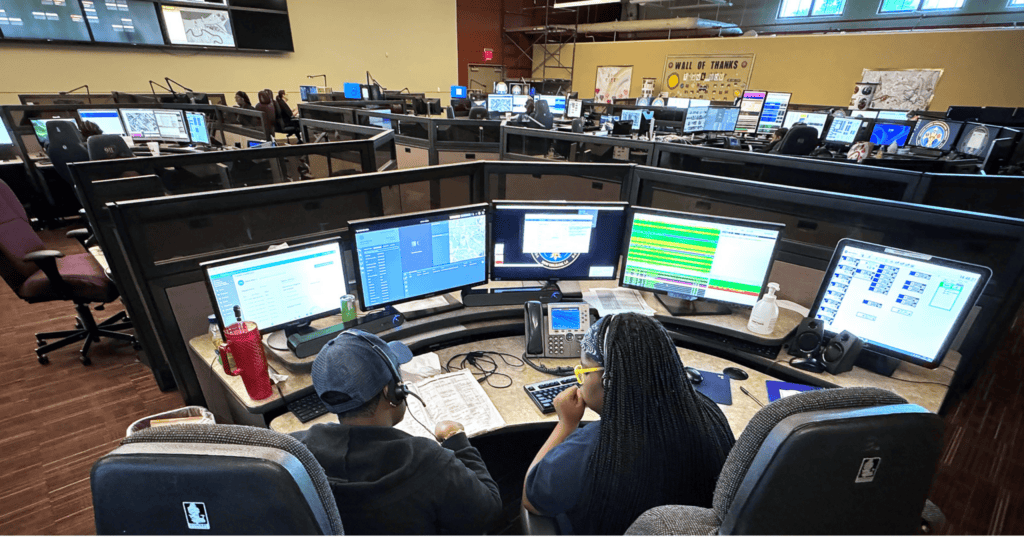
The reports created the impression that a person experiencing an emergency in New Orleans could call 911 and reach an AI agent instead of a trained human call taker. The Orleans Parish Communication District, the agency responsible for handling emergency calls in New Orleans, said it is not replacing its employees with artificial intelligence. Karl Fasold, the district’s executive director, said the technology assists human call takers with a limited category of duplicate reports.
The district addressed the coverage directly in a statement titled, “No, New Orleans 911 is not replacing human call-takers with AI.”
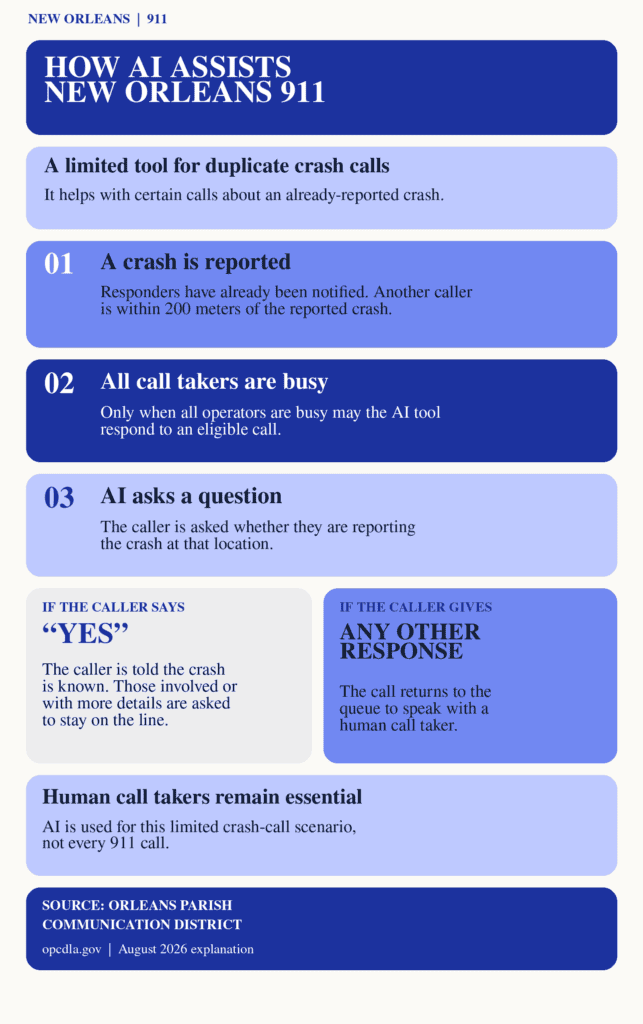
The AI system does not independently answer every call made to 911. It is activated only under a specific set of circumstances involving a vehicle crash that has already been reported. When another person calls from within 200 meters of the crash, the system can ask whether the caller is reporting that same incident. The AI tool is used only when human call takers are already occupied, according to Axios New Orleans.
If the caller confirms that the call concerns the crash already on record, the system can collect additional information about the incident. If the caller gives any response other than “yes,” in any language, the call is immediately transferred to a human.
That safeguard is important because proximity to a reported crash does not necessarily mean a caller is reporting an earlier crash. Someone in the area could be calling about a medical emergency, a fire, a crime or another dangerous situation. The system is designed to recognize that possibility and return the caller to the human dispatch process.
The technology’s purpose is to reduce the number of duplicate crash reports occupying emergency lines. A serious collision can prompt several people nearby to call 911 at nearly the same time, officials said.. Each caller may be trying to report the same event while other people are waiting to report unrelated emergencies.
By screening a limited number of those calls, the district says the system can help human call takers concentrate on emergencies that have not already been reported. Human employees remain responsible for evaluating emergency situations and coordinating responses from police officers, firefighters and emergency medical personnel.
The distinction between assisting call takers and replacing them became blurred as the story moved from one outlet to another. New Orleans is using AI in connection with some 911 calls, but the technology is not serving as a substitute for human dispatchers across the city’s emergency communication system.
The original headline contained an element of truth that made the claim easier to spread. In certain circumstances, an AI agent may be the first voice a caller hears. However, leaving out the system’s geographic limit, its focus on previously reported crashes and its requirement to transfer other calls to a person produced a significantly different impression of the program.
New Orleans is still the first city in the country to use this type of AI technology in a 911 center, according to the communication district and Axios New Orleans. That distinction is noteworthy, but it does not mean New Orleans became the first major American city to turn its emergency phone lines over to artificial intelligence.
The difference also demonstrates why descriptions of emerging technology require precise language. Saying that New Orleans uses AI to assist with certain duplicate crash reports is accurate. Saying the city uses AI instead of people to answer 911 calls suggests a much broader replacement of human workers that has not occurred.
The Shreveport Times’ correction now provides more accurate information about the program, but corrections do not always travel as widely as the claims they address. Readers who encountered the original framing through national coverage may never have seen the later clarification.
A sensational headline can strip away the safeguards and restrictions that define a technology’s actual use. New Orleans has introduced AI into a narrow part of its emergency call system. Its human call takers have not been replaced.
Sources
Axios New Orleans. Chelsea Brasted, “No, AI isn’t answering all of New Orleans’ 911 calls,” Aug. 13, 2026. Axios New Orleans
Fox News. “New Orleans deploys AI to answer 911 calls,” video segment, Aug. 11, 2026. Fox News Video
New York Post. Report on New Orleans’ use of AI for 911 calls.
Newsweek. Report on New Orleans and AI-assisted 911 calls.
Orleans Parish Communication District. Official website.
Orleans Parish Communication District. “No, New Orleans 911 is NOT replacing humans with AI,” Aug. 9, 2026, with an Aug. 10 update. Orleans Parish Communication District.
Orleans Parish Communication District. “Our Staff,” including Executive Director Karl Fasold’s profile. Orleans Parish Communication District.
The Shreveport Times. Report on New Orleans’ use of AI in 911 calls.